China (中国)
China (i/ˈtʃaɪnə/; Chinese: 中国; pinyin: Zhōngguó; see also Names of China), officially the People's Republic of China (PRC), is the world's most-populous country, with a population of over 1.3 billion. Covering approximately 9.6 million square kilometres, the East Asian state is the world's second-largest country by land area, and the third- or fourth-largest in total area, depending on the definition of total area.

The People's Republic of China is a single-party state governed by the Communist Party of China. It exercises jurisdiction over 22 provinces, five autonomous regions, four directly controlled municipalities (Beijing, Tianjin, Shanghai, and Chongqing), and two mostly self-governing special administrative regions (Hong Kong and Macau). Its capital city is Beijing. The PRC also claims Taiwan—which is controlled by the Republic of China (ROC), a separate political entity—as its 23rd province, a claim controversial due to the complex political status of Taiwan and the unresolved Chinese Civil War. The PRC government denies the legitimacy of the ROC.
China's landscape is vast and diverse, with forest steppes and the Gobi and Taklamakan deserts occupying the arid north and northwest near Mongolia and Central Asia, and subtropical forests being prevalent in the wetter south near Southeast Asia. The terrain of western China is rugged and elevated, with the Himalaya, Karakoram, Pamir and Tian Shan mountain ranges separating China from South and Central Asia. The Yangtze and Yellow Rivers, the third- and sixth-longest in the world, have their sources in the Tibetan Plateau and continue to the densely populated eastern seaboard. China's coastline along the Pacific Ocean is 14,500 kilometres (9,000 mi) long—the 11th-longest in the world—and is bounded by the Bohai, Yellow, East and South China Seas.
The nation of China has had numerous historical incarnations. The ancient Chinese civilization—one of the world's earliest—flourished in the fertile basin of the Yellow River in the North China Plain. China's political system was based on hereditary monarchies, known as dynasties, beginning with the semi-mythological Xia of the Yellow River basin (approx. 2000 BC) and ending with the fall of the Qing Dynasty in 1911. Since 221 BC, when the Qin Dynasty first conquered several states to form a Chinese empire, the country has expanded, fractured and been reformed numerous times. The Republic of China, founded in 1911 after the overthrow of the Qing dynasty, ruled the Chinese mainland until 1949. In 1945, the ROC acquired Taiwan from Japan following World War II.
In the 1946–1949 phase of the Chinese Civil War, the Chinese Communist Party defeated the nationalist Kuomintang in mainland China and established the People's Republic of China in Beijing on 1 October 1949. The Kuomintang relocated the ROC government to Taiwan, establishing its capital in Taipei. The ROC's jurisdiction is now limited to Taiwan and several outlying islands, including Penghu, Kinmen and Matsu. Since 1949, the People's Republic of China and the Republic of China (now widely known as "Taiwan") have remained in dispute over the sovereignty of China and the political status of Taiwan, mutually claiming each other's territory and competing for international diplomatic recognition. In 1971, the PRC gained admission to the United Nations and took the Chinese seat as a permanent member of the U.N. Security Council. China is also a member of numerous formal and informal multilateral organizations, including the WTO, APEC, BRICS, the Shanghai Cooperation Organisation, the BCIM and the G-20. As of September 2011, all but 23 countries have recognized the PRC as the sole legitimate government of China.
Since the introduction of market-based economic reforms in 1978, China has become the world's fastest-growing major economy. As of 2012, it is the world's second-largest economy, after the United States, by both nominal GDP and purchasing power parity (PPP), and is also the world's largest exporter and second-largest importer of goods. On a per capita income basis, China ranked 90th by nominal GDP and 91st by GDP (PPP) in 2011, according to the IMF. China is a recognized nuclear weapons state and has the world's largest standing army, with the second-largest defense budget. In 2003, China became the third nation in the world, after the former Soviet Union and the United States, to independently launch a successful manned space mission. China has been characterized as a potential superpower by a number of academics, military analysts, and public policy and economics analysts.
http://en.wikipedia.org/wiki/China
Zhonghua minzu (中華民族)
Zhonghua minzu (simplified Chinese: 中华民族; traditional Chinese: 中華民族; pinyin: Zhōnghuá Mínzú), usually translated as Chinese ethnic groups or Chinese nationality, refers to the modern notion of a Chinese nationality transcending ethnic divisions, with a central identity for China as a whole. It includes people of all ethnic groups in China who have historically interacted, contributed and assimilated to various extents with Chinese civilization.
Professor Suisheng Zhao, University of Denver, using extensive reading of primary sources noted that because "Chinese" or Zhonghua minzu as a conscious national identity (自觉的民族实体 zijue de minzu shiti) only arose in the 19th century, since nationalism in the modern sense only appeared with the emergence of the nation-state system (Westphalian system) in Europe. Although the Chinese empire stretched back two millennia, it was largely a universalistic empire and not a nation-state before the 19th century.
The boundaries of Zhonghua minzu are fuzzy and controversial, but most Chinese today use the term to include all peoples within the territorial boundaries of China integrated as one national, political, and cultural group. It is sometimes also extended to overseas Chinese.
Zhonghua refers to the concept of "China" and is the term used in the formal names for both the People's Republic of China and the Republic of China. (See: Names of China) Minzu can be translated as "nationality", "people", or "ethnic groups".
Confusion can arise because the term "Chinese" in Western languages is often used to refer both to Zhonghua minzu and to the Han ethnicity, two concepts which are usually kept distinct among modern Chinese speakers.
http://en.wikipedia.org/wiki/Zhonghua_minzu
Chinese language
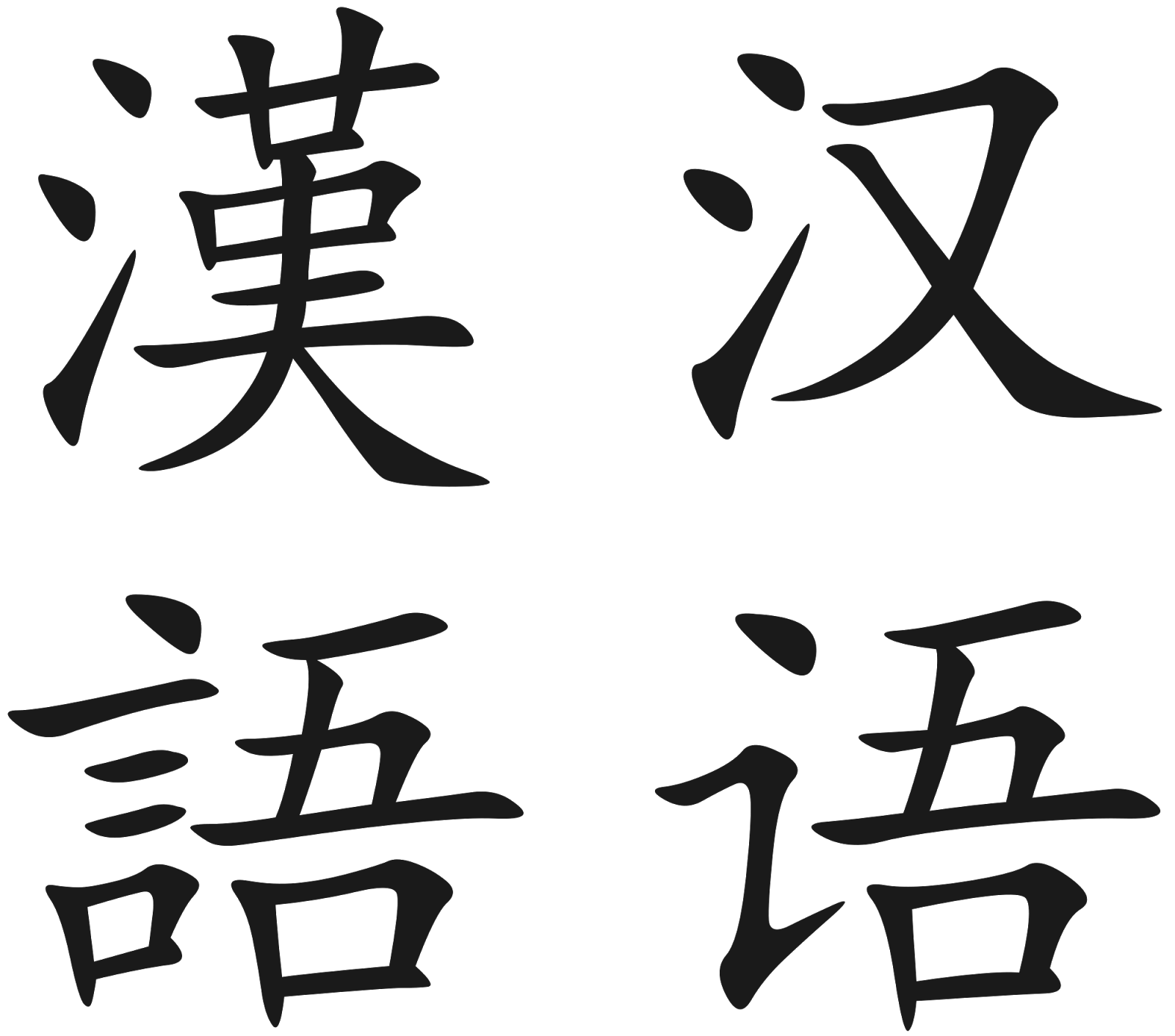
The Chinese language (汉语/漢語 Hànyǔ, 华语/華語 Huáyǔ, or 中文 Zhōngwén) is a language or language family consisting of varieties which are mutually intelligible to varying degrees, with most of the varieties not being mutually intelligible.[4] Originally the indigenous languages spoken by the Han Chinese in China, it forms one of the branches of Sino-Tibetan family of languages. About one-fifth of the world's population, or over one billion people, speaks some variety of Chinese as their native language. Internal divisions of Chinese are usually perceived by their native speakers as dialects of a single Chinese language, rather than separate languages, although this identification is considered inappropriate by some linguists and sinologists.[5]
Chinese is distinguished by its high level of internal diversity, although all varieties of Chinese are tonal and analytic. There are between 7 and 13 main regional groups of Chinese (depending on classification scheme), of which the most spoken, by far, is Mandarin (about 850 million), followed by Wu (90 million), Cantonese (Yue) (70 million) and Min (50 million). Most of these groups are mutually unintelligible, although some, like Xiang and the Southwest Mandarin dialects, may share common terms and some degree of intelligibility.
Standard Chinese (Putonghua / Guoyu / Huayu) is a standardized form of spoken Chinese based on the Beijing dialect of Mandarin Chinese, referred to as 官话/官話 Guānhuà or 北方话/北方話 Běifānghuà in Chinese. Mandarin Chinese history can be dated back to the 19th century, particularly by the upper classes and ministers in Beijing.[6] Standard Chinese is the official language of the People's Republic of China (PRC) and the Republic of China (ROC, also known as Taiwan), as well as one of four official languages of Singapore. It is one of the six official languages of the United Nations.
Of the other varieties of Chinese, Cantonese is influential in Guangdong Province and Cantonese-speaking overseas communities, and remains one of the official languages of Hong Kong (together with English) and of Macau (together with Portuguese). Min Nan, part of the Min language group, is widely spoken in southern Fujian, in neighbouring Taiwan (where it is known as Taiwanese or Hoklo) and in Southeast Asia (known as Hokkien in Philippines, Singapore and Malaysia). There are also sizeable Hakka and Shanghainese diasporas, for example in Taiwan, where most Hakka communities maintain diglossia by being conversant in Taiwanese and Standard Chinese.
http://en.wikipedia.org/wiki/Chinese_language
Chinese Proverb
Advice
¶ Do not use a hatchet to remove a fly from your friend’s forehead.
¶ 用人不疑疑人不用 [yòngrénbùyí yírénbùyòng]
Don't suspect your employee. If one is suspicious, don't employ him.
Belief
¶ Listen to all, but follow no one absolutely.
Courage
¶ Use power to curb power.
Generation
¶ 長江後浪推前浪 [Chángjiāng hòulàng tuī qiánlàng]
The Changjiang River(長江) waves behind drive the waves ahead.
Happiness
¶ One joy scatters a hundred grief.
Humility
¶ True goodness springs from a man's own heart.
¶ Virtue is not left to stand alone.
¶ When you drink the water, remember the spring.
Judgement
¶ 盖棺论定[gàiguānlùndìng]
Only when a man is dead can he be judged.
Money
¶ Our brothers keep careful accounts.
Wisdom
¶ The cowl does not make the monk.
Writing
¶ Never write a letter while you are angry.
Notes
Chinese language
[5]^ Mair, Victor H. (1991). "
What Is a Chinese "Dialect/Topolect"? Reflections on Some Key Sino-English Linguistic Terms" (PDF). Sino-Platonic Papers.
[6]^ "
History of Mandarin Chinese". Languagetutoring.co.uk. Retrieved 2012-11-07.
http://en.wikipedia.org/wiki/China
http://en.wikipedia.org/wiki/Zhonghua_minzu
http://en.wikipedia.org/wiki/Chinese_language
http://en.wikiquote.org/wiki/Chinese_proverbs
People:
China (中国)
China:
China (中国)
Where:
China (中国)